
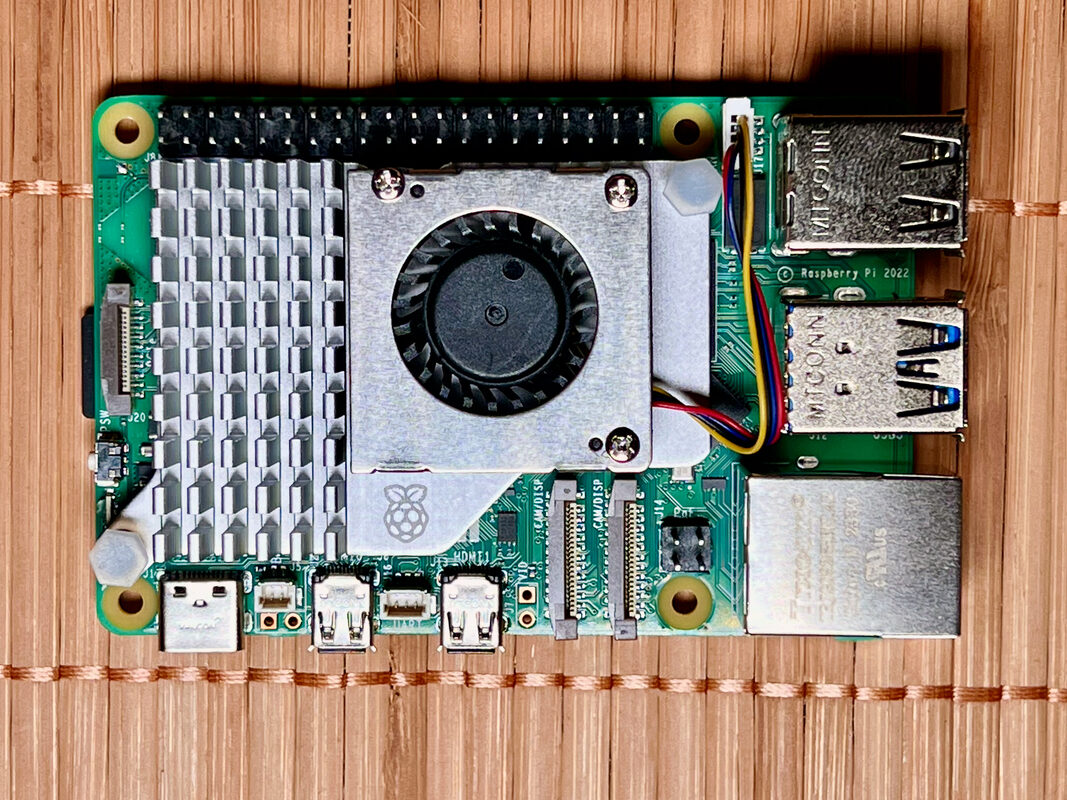
Sixfab is selling an AI HAT+ for the Raspberry Pi 5 that carries a DEEPX DX-M1M neural processing unit rated at 25 TOPS. Raspberry Pi wrote about the third-party board in an October 5, 2026 post on its news blog, which includes the company's own benchmarks for image classification, segmentation and small-language-model workloads, and says the 25 TOPS board is "available now from Sixfab". On Sixfab's product page, the 25 TOPS variant is in stock at US$95 in the shop's variant selector as of October 20, 2026, although the page's comparison card for the same variant shows $90. A 13 TOPS version is listed at US$63 and is out of stock.
Two NPUs, one board
Sixfab's product page lists two variants that share the same PCB, form factor and software stack; only the soldered NPU differs:
| 13 TOPS variant | 25 TOPS variant | |
|---|---|---|
| NPU | DEEPX DX-M1ML | DEEPX DX-M1M |
| Performance | 13 TOPS at INT8 | 25 TOPS at INT8 |
| NPU memory | 1 GB LPDDR4X | 2 GB LPDDR4X |
| Price | $63 | $95 in the selector ($90 on the comparison card; marked "Recommended") |
Both variants connect to the Pi over PCIe Gen 3 ×1 through a 16-pin FFC cable and take 5 V through the Pi 5's 2×20-pin header and the PCIe connector. Sixfab rates the NPU at 3 W (typical), and says a Pi 5 with the HAT+ attached runs at 13–15 W on the official 27 W power supply. Raspberry Pi gives a similar figure for the 25 TOPS board, "approximately 3 W of typical sustained NPU power", and notes that this is not complete system wall power, so builders should measure their own configuration. The board is 56.5 × 65 mm and 6.56 mm tall, is cooled passively, and is rated for 0–70 °C. CE, FCC, UKCA, RoHS and REACH certification is listed as in progress.
The board's NPUs belong to DEEPX's DX-M1 family. On the DX-M1 product page, DEEPX rates the DX-M1 chip at 25 TOPS (INT8). The chip supports LPDDR4x or LPDDR5 memory up to 8GB and connects over PCIe Gen3 x4, with x1 and x2 also supported. DEEPX's own DX-M1 M.2 module uses 4GB of LPDDR5 and draws 5W (Typical). DEEPX does not publish specifications for the DX-M1M on that page.
Raspberry Pi's benchmarks
Raspberry Pi tested on a Raspberry Pi 5 (8 GB) running the shipping Sixfab software release, comparing the AI HAT+'s DX-M1M against DEEPX's DX-M1. Its reported results:
| Workload | DX-M1M (Sixfab AI HAT+) | DX-M1 |
|---|---|---|
| mobilenet_v2, 240×240 | 2361 FPS | 3223 FPS |
| deeplabv3plus, 512×512 | 155 FPS | 231 FPS |
| Qwen3-1.7B, time to first token (96 prefill tokens) | 599.04 ms | 544.58 ms |
| Qwen3-1.7B, generation rate | 4.64 tok/s | 11.60 tok/s |
Raspberry Pi attributes the differences to memory bandwidth: the DX-M1 uses LPDDR5, while the DX-M1M uses LPDDR4X. These are Raspberry Pi's measurements on that hardware and software release, and do not carry over to other models, resolutions or software versions. Raspberry Pi also says the DX-M1M's 2 GB of on-module memory supports vision-language and small-language-model workloads alongside vision models. Sixfab's own product page takes a narrower position: it describes the current generation as optimised for computer vision and says it does not support LLMs yet, with LLM support on the DEEPX roadmap.
Software stack
Raspberry Pi's post lists the DEEPX toolchain that supports the board:
- DX-COM, which optimises and compiles supported ONNX models into .dxnn artifacts
- the DX-RT runtime, with C++ and Python APIs
- DX-Stream, for GStreamer-based capture, inference and post-processing pipelines
- a ModelZoo of pre-optimised examples
- the dxrt-cli and dxtop utilities for device status and NPU monitoring
Sixfab's quickstart guide has ten steps and an estimated time of about 20 minutes. The runtime is installed with sudo apt install sixfab-dx, which takes 5–10 minutes depending on the connection, and PCIe Gen 3 has to be enabled on the Pi. The guide then uses dxrt-cli -s to confirm the driver, runtime and on-NPU firmware versions, and run_hello_world starts a live YOLOv5 object-detection demo on the NPU. The board is HAT+ compliant with EEPROM auto-configuration, and runs on Raspberry Pi OS (Trixie).
What It Means for Makers
The board is aimed at Raspberry Pi 5 projects that run vision models locally, such as classification, segmentation and object detection, without a cloud connection. Sixfab supports only the Raspberry Pi 5; it does not support the Pi 4, Compute Module 4, Compute Module 5 on the CM5 IO Board, or non-Raspberry Pi SBCs. Hot-plugging is not supported, so the Pi has to be powered off before the HAT+ is mounted.
Anyone planning to run language models should weigh Raspberry Pi's Qwen3-1.7B results against Sixfab's statement that LLMs are not yet supported, and check Sixfab's documentation before buying for that workload. Sixfab recommends the Raspberry Pi Active Cooler for sustained full NPU use; the Pi 5, official 27 W USB-C power supply, microSD card and camera are not included in the box.
The 25 TOPS board can be ordered directly from Sixfab now. The 13 TOPS board is out of stock, and Raspberry Pi expects it "to launch toward the end of 2026"; Sixfab lists both SKUs as "Available by Q4, 2026", a quarter that has already begun. Because the shop selector charges $95 while the comparison card shows $90 for the 25 TOPS variant, buyers should confirm the price at checkout.
