
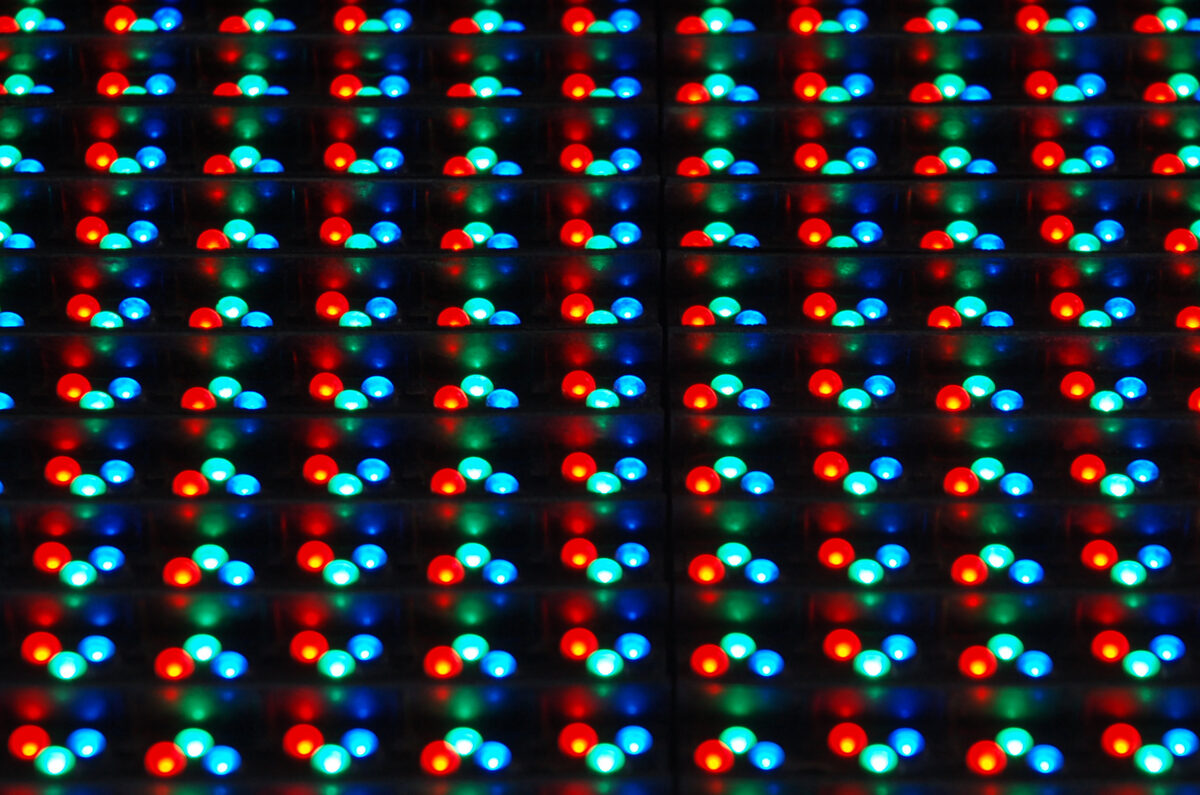
Patternflow, an "open-source LED synthesizer" from Seoul artist SeungHun Lee (who publishes as engmung), has finished crowdfunding. Its Crowd Supply campaign ran until October 15, 2026, and ended funded with $23,779 raised against a $10,000 goal, or 237%, from 51 backers. Lee had already announced in a September 15, 2026 campaign update that the goal had been reached. Patternflow is now available for pre-order. A fully assembled, tested and flashed unit costs $269 as of October 20, 2026, plus $8 shipping in the US or $18 worldwide. Crowd Supply says orders placed now ship April 8, 2027. That is an estimated delivery date for a crowdfunded product, and the hardware has not shipped yet.
The campaign's tagline is "Play Light With Your Fingertips." The device has four rotary knobs, and turning them reshapes a generative pattern on a 128 x 64 RGB LED matrix in real time. Every frame is computed on the ESP32-S3 as it appears. Nothing is pre-rendered, and nothing streams pixels to the panel.
What the hardware is
The build is simple: a socketed Espressif dev board, a standard HUB75 panel, four encoders and a printed case. Crowd Supply lists these specifications for the assembled unit:
| Item | Specification |
|---|---|
| Microcontroller | ESP32-S3-DevKitC-1-N16R8, socketed |
| Display | HUB75 128 x 64 P2.5 indoor RGB LED matrix (320 x 160 mm) |
| Controls | Four EC11 rotary encoders with push switches |
| Power | 5 V USB, into a rear screw terminal (USB power supply not included) |
| Enclosure | Snap-fit, 3D-printed PLA, with built-in wall-mount holes |
| Dimensions | 245 x 325 x 36 mm; knobs add 55 mm of depth |
| Weight | 933 g |
The GitHub repository fills in the rest. The N16R8 board has 16 MB of flash and 8 MB of PSRAM and plugs into sockets instead of being soldered. It sits on a v3.9 custom PCB on which every soldered part is through-hole. The encoders are Bourns PEC11R-4220F-S0024 EC11 parts with a 20 mm shaft. On the Hackaday.io project page, Lee writes that he removed every SMD part from the PCB and redesigned the enclosure with snap-fits so that a large-format printer could print it in one piece. Crowd Supply says the funded units will be printed and assembled by hand in Korea.
Patternflow runs from a USB power bank that fits a compartment inside the case. Crowd Supply says the compartment takes banks up to 150 x 70 x 27 mm and estimates about four hours of run time per 10,000 mAh at full brightness. One detail matters to buyers: Crowd Supply's spec lists a rear screw terminal as the power input for the assembled unit, while Lee wrote on Hackaday.io that the Crowd Supply unit keeps a USB-C input and only the DIY version uses the two-pin screw terminal.
Where it comes from
Lee describes himself as "A Seoul-based artist making interactive media art," and Patternflow is his first hardware build: "First time holding a soldering iron. First PCB I ever drew." He is the only team member on the Hackaday.io project, which he created on July 1, 2026. The project is inspired by Nam June Paik's Participation TV (1963), in which a visitor speaks into a microphone and the picture on the screen moves with their voice. Patternflow replaces the microphone with four knobs that shape a creative-coding pattern.
Licensing and source files
Firmware, web code and tools are under the MIT license. Hardware, designs and documentation are under CC BY-SA 4.0, as are the presets bundled with the firmware and editor. Community-contributed patterns carry their authors' own licenses, usually CC BY-SA 4.0 or CC BY 4.0. The KiCad source, Gerbers and schematic are in the repository's hardware/ directory. "Patternflow" itself is a trademark of SeungHun Lee.
The patterns also run in a browser. A Live Editor at patternflow.work/pattern simulates the same four knobs as the physical device, so patterns can be written and previewed without hardware.
The firmware comes in several editions: MIDI, OSC, MQTT and audio-react builds of the same code. The Audio edition splits sound into four bands, taking input either from a browser tab or from a $5 PDM microphone soldered to the DevKit.
What It Means for Makers
- Buy or build: Crowd Supply sells the finished unit on pre-order. To build one yourself, the repository estimates "about US$100–200 in parts" for the v3.9 board in a 3D-printed case and links to the BOM and build guide.
- Panel caveat: The repository warns that a HUB75 panel matching the size and pitch spec "can still stay completely dark" if its driver chips are wrong. DIY builders should source a panel that matches the BOM.
- Who it is for: Creative coders and visual performers. Crowd Supply lists two-way OSC over Wi-Fi with Max, Ableton (via Max for Live) and TouchDesigner, with no audio interface needed.
- Try first: The browser Live Editor runs the pattern code before you buy or build anything.
- Power: Plan on supplying your own USB power bank that fits the case compartment. The repository says the DevKit's own USB-C ports are for flashing only and should not be used to power the device.
- Timing: April 8, 2027 is the campaign's estimated ship date and may change.
