
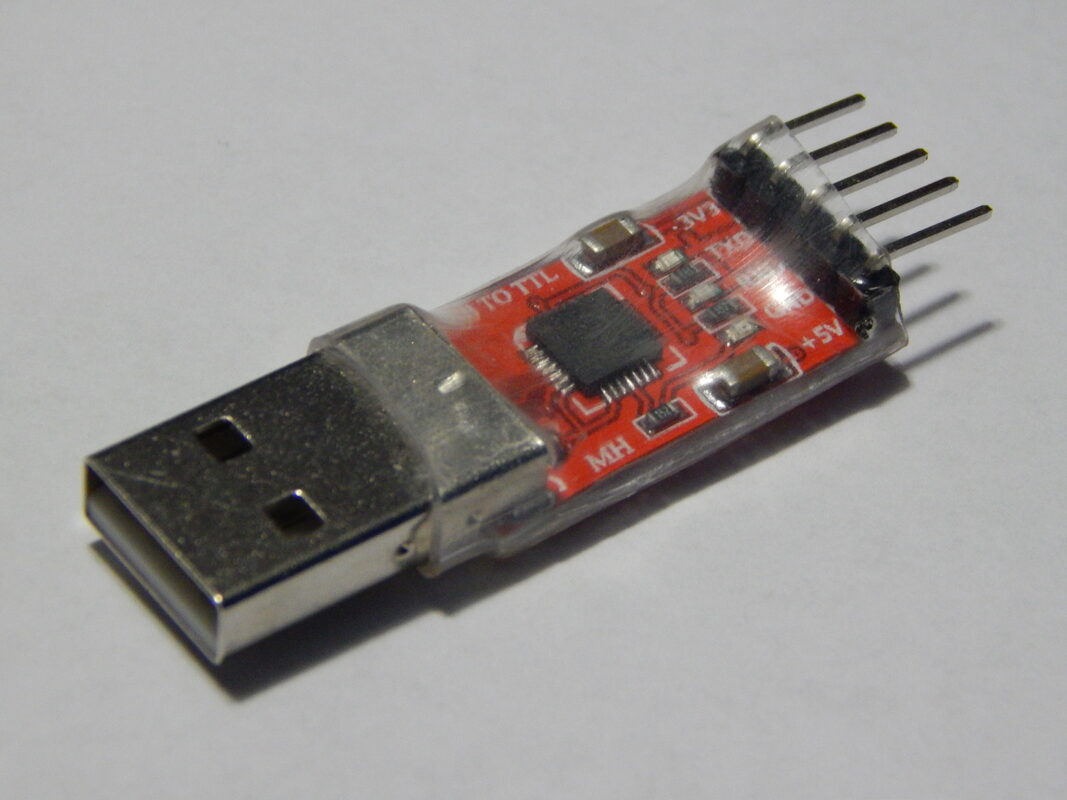
Adafruit is now selling the CP2105 Friend (product ID 6065), a USB-to-serial adapter built on Silicon Labs' CP2105. It connects over USB-C and gives the host two UARTs. As of October 20, 2026, the board is in stock at $6.95 each for 1–9 units, $6.26 for 10–99 and $5.56 for 100 or more. Adafruit featured it on its blog as "Adafruit New Product this Week: Adafruit CP2105 Friend – USB to Dual UART Serial Converters" on October 17, 2026, three days earlier.
The pitch is two serial devices on one USB port. Adafruit's Learn guide says both ports enumerate when the board is plugged in, "without any hub required!" The two UARTs are not identical, though. One is an "Enhanced" port and the other a "Standard" port, and their limits differ enough to affect which one you use for what.
Two ports, two feature sets
Adafruit's product page lists these per-port specifications:
| Enhanced UART | Standard UART | |
|---|---|---|
| Position on board | Left | Right |
| Baud rate | 300 bps–2.0 Mbps | 2400–921600 bps |
| Data bits | 5, 6, 7 or 8 | 8 |
| Stop bits | 1, 1.5 or 2 | 1 |
| Parity | Odd, even, mark, space, none | Even, odd, none |
| RX/TX buffers | 320-byte | 288-byte |
| Modem signals | CTS, RTS, DTR, DSR, RI | CTS, RTS, DTR, DSR, RI |
The Standard port is the simpler of the two: a fixed 8-data-bit, one-stop-bit frame, no mark or space parity, and a lower ceiling. Anything with 5, 6 or 7 data bits, 1.5 or 2 stop bits, or a rate above 921600 bps has to go on the Enhanced port.
Adafruit ships the board with the CP2105's modem-signal one-time fuse already programmed. The handshake and modem-control lines therefore "will 'just work'", but they can't be used as GPIOs the way they can on a fresh chip. In the guide's pinout, DSR, CTS and RI are active-low control inputs and RTS and DTR are active-low control outputs on both ports.
The board
The CP2105 comes in a 24-QFN 4x4 package and connects to the host over USB 2.0 through the USB-C connector. The board measures 28.9 x 17.8 x 5.1 mm, weighs 2.4 g and is rated for -40 to 85°C. Each order includes a fully assembled and tested board plus a 16-pin header strip to solder in for breadboard use. There are no extra GPIO pads or indicator LEDs, and the bottom row of pads carries only the two RX/TX pairs and the power pins.
The product page gives a supply voltage of "1.8V, or 3V to 3.6V" and a supply current of 17 mA. On the power pins, the guide describes 5V as the USB 5V output, able to supply ~100mA peak, and 3V as the output of the 3.3V regulator, also ~100mA peak. Adafruit does not state the logic level of the UART pins or whether they are 5V tolerant.
Adafruit describes the board as a sibling of its CP2102N breakout: the same USB-C connector and overall shape, with a different pinout to carry the second UART. Adafruit also points to the CP210x series' driver support and high, stable speeds as reasons for building on it.
Open design files
The EagleCAD schematic (.sch) and board layout (.brd) are in the Adafruit-CP2105-Friend-PCB repository on Adafruit's GitHub. The repository credits Limor Fried/Ladyada for Adafruit Industries as designer and licenses the files under Creative Commons Attribution/Share-Alike.
What It Means for Makers
- Who it is for: anyone who wants to connect two serial devices to one USB port without adding a hub.
- Not a GPIO expander: with the modem lines fused and no spare pads, the board offers serial ports and nothing else.
- Drivers: Linux needs no driver. Windows installs one automatically through Windows Update. macOS needs Silicon Labs' driver.
- Customising: the CC BY-SA EagleCAD files can be adapted for your own board, with derivatives under the same license.
- Where to get it: directly from Adafruit, which offers the quantity pricing listed above.
Sources
- Adafruit: CP2105 Friend - USB to Dual UART Serial Converters (product 6065)
- Adafruit Learning System: Adafruit CP2105 Friend guide
- GitHub: adafruit/Adafruit-CP2105-Friend-PCB
- Adafruit blog: "Adafruit New Product this Week: Adafruit CP2105 Friend – USB to Dual UART Serial Converters", October 17, 2026
