
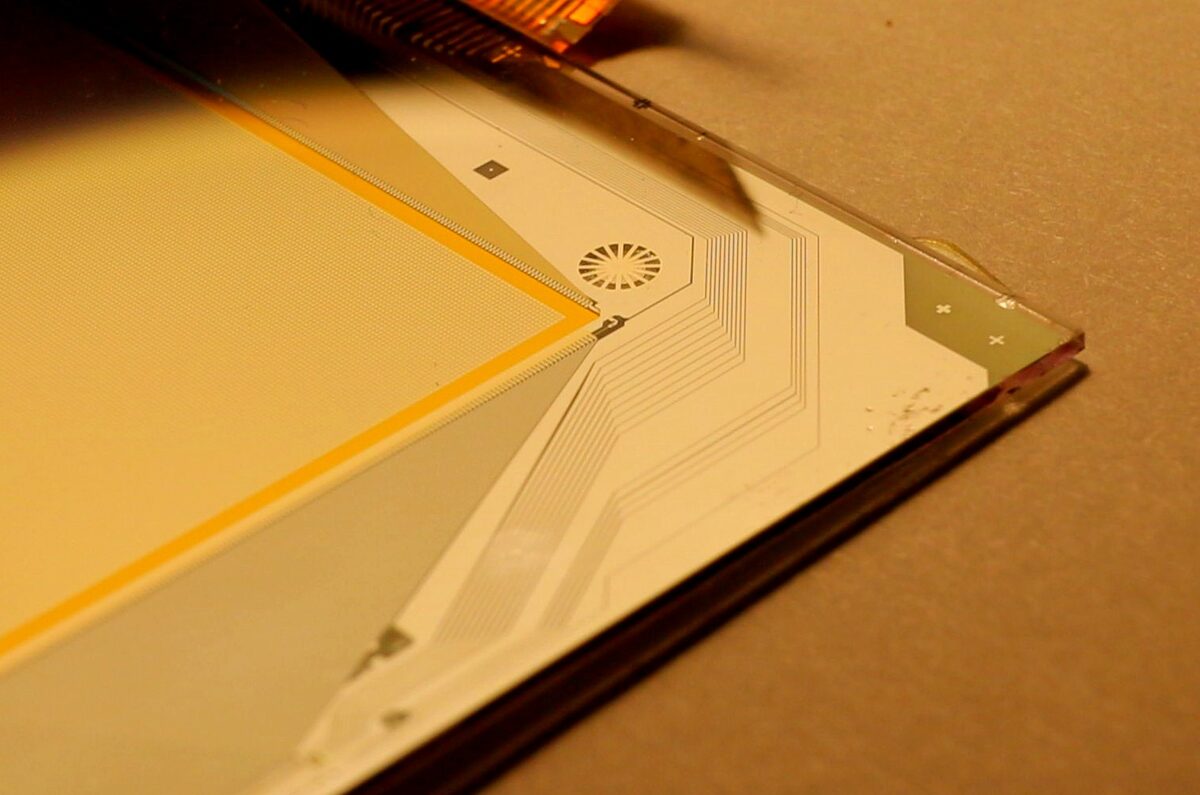
M5Stack has released PaperDIY, a 4.7-inch e-paper development kit built around an Espressif ESP32-S3 module, in two versions. The PaperDIY Assembly Kit (SKU K159) is a bare main board, panel and battery that the buyer puts together. The PaperDIY Complete Kit (SKU K159-B) is the same hardware assembled at the factory inside a 3D-printed PLA enclosure. CNX Software reported the launch on October 18, 2026.
The hardware
M5Stack's store listing gives these specifications for the Assembly Kit:
- SoC: ESP32-S3-WROOM-1-N16R8 @ Xtensa® 32-bit LX7 dual-core processor, 240MHz
- Memory: 16MB flash, 8MB Octal PSRAM
- Wireless: 2.4 GHz Wi-Fi
- Display: ED047TC1 e-paper, 540 x 960 at 4.7 inches, 16-level grayscale, no touch
- Storage: microSD slot
- Controls: one power button (ON / OFF / RESET / BOOT) and two user buttons
- Expansion: 2x FPC 0.5mm-12P
- Power: 3.7V battery, USB Type-C (DC 5V) or a 5V pad, managed by M5Stack's M5PM1 power-management chip
- Battery: 140mAh, SH1.0-2P connector
- Operating power consumption: [email protected] (peak up to 161mA)
- Operating temperature: 0 ~ 40°C
- Size and weight: 115.3 x 62.5 x 5.5mm, 26.4g
The box contains the e-paper display, the main control board, the 140mAh battery and an acrylic screen pressure plate. CNX adds a few details M5Stack's pages leave out: the panel is driven over an 8-bit parallel interface, the module's radio also supports Bluetooth 5.0 LE alongside Wi-Fi 4, and the two FPC connectors expose I2S and SPI signals.
The Complete Kit documentation lists the same module, memory, panel resolution, battery and power figures. The enclosure makes it a little larger and heavier, at 120.0 x 68.2 x 6.3mm and 43.1g. M5Stack says the enclosure model is open source and can be re-printed or modified. The back has M2 screw holes, and M5Stack's documentation warns: "If the screws are too long, they will press against the screen and cause screen damage." It specifies screws with a thread length under 3mm.
Price and availability
As of October 20, 2026, M5Stack's store lists the Assembly Kit at $25.00 USD and "10+ In Stock," and the Complete Kit at $29.90 USD and out of stock. CNX reported that the Assembly Kit also sells for $25 on AliExpress, a separate retail channel whose price can move independently of M5Stack's store.
Where it fits
PaperDIY is a stripped-down relative of M5Stack's existing 4.7-inch e-paper devices. The original M5Paper, which CNX dates to 2020, uses an ESP32-D0WDQ6-V3, an ED047TC1 panel driven by an IT8951E controller, a GT911 capacitive touch panel, an SHT30 temperature and humidity sensor, a BM8563 RTC and a 1150mAh battery, according to M5Stack's documentation. CNX describes PaperDIY as dropping the touchscreen and sensors while upgrading to an ESP32-S3. CNX also points to LilyGo's T5 4.7-inch E-Paper S3 Pro as a board that uses the same ED047TC1 display and ESP32-S3, with expansion options that include an optional 18650 battery holder.
Software
The factory firmware is in M5Stack's M5PaperDIY-UserDemo repository, which covers both K159 and K159-B, builds with ESP-IDF v5.5.1 and is MIT licensed. Its demos cover battery voltage monitoring, Wi-Fi network scanning, a TF card read/write test, A/B button feedback and A+B long-press shutdown. The Complete Kit documentation also lists an Arduino quick start guide, an M5PM1 power-management guide, the M5PM1, M5Unified and M5GFX Arduino libraries, a UiFlow2 quick start guide and a WebBurner for restoring the factory firmware.
What It Means for Makers
The Assembly Kit is aimed at people who want to design their own housing or mounting; M5Stack's suggested uses include DIY desktop information displays and custom electronic labels and signage. Buyers who just want a finished, cased panel to put on a desk should pick the Complete Kit, once M5Stack restocks it. Anyone who needs touch input is better served by M5Stack's touch-equipped e-paper devices, since this panel has none.
M5Stack's M5PM1 power-management guide is the place to start for battery-powered builds. For charging and battery handling, follow M5Stack's documentation rather than improvising. Builders planning add-on boards for the two FPC connectors should work from the hardware design files and K159-B structure files that M5Stack links from the Complete Kit documentation, not the trade-press summary of which signals are exposed.
One detail for driver work: the Complete Kit documentation names the panel ET047TC1 rather than ED047TC1, so confirm the part with M5Stack before tuning waveforms for it.
Sources
- PaperDIY Assembly Kit (ESP32-S3), M5Stack store
- PaperDIY Complete Kit (ESP32-S3), M5Stack store
- PaperDIY Complete Kit documentation, M5Stack Docs
- M5Paper documentation, M5Stack Docs
- M5PaperDIY-UserDemo factory firmware, M5Stack on GitHub
- M5Stack PaperDIY Kits pair an ESP32-S3 MCU with a 4.7-inch e-Paper display, CNX Software (October 18, 2026)
