
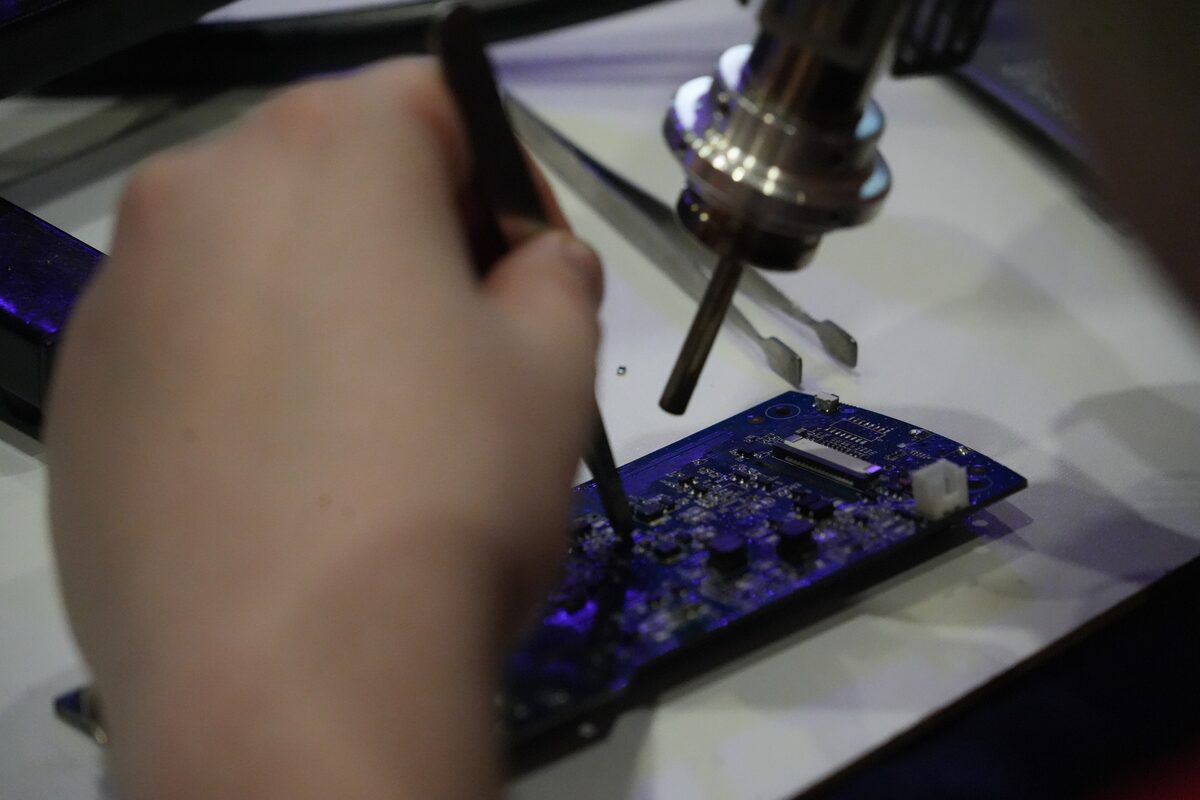
Nicholas Ficara, one of the organisers of Hack the North, has published a detailed write-up of the programmable PCB badge handed to hackers at this year's event. The post went up on 13 October 2026, and the design was released alongside it: the KiCad hardware files, the GPL-3.0 firmware and a browser emulator that runs the firmware compiled to WebAssembly. Hack the North, "Canada’s biggest hackathon" in Ficara's words, took place on 18 September. The team built 1,750 populated badges for hackers plus 750 blank boards for volunteers.
The badges were made for attendees, and the post is a project retrospective, not a product launch. Ficara puts the cost at "about $20,300 for 1,750 assembled boards, or roughly $11.60 per populated badge". That figure leaves out R&D, batteries, extra screens and event NFC stickers. The original pitch was "$5 / head (boy was I naive)".
What the badge does
Ficara's first pitch called for LEDs, a screen, a battery, buttons, audio and wireless features. Hackster.io's Nick Bild describes the first prototype as a hexagonal PCB with an ESP32, a small colour display, addressable LEDs and NFC. Later revisions redesigned the board to resemble a miniature handheld game console.
Most of the attendee-facing work is in the software. According to the badge-firmware README, the firmware provides:
- a 4x4 grid launcher with page navigation
- games including Snake, Tetris, Breakout, Tic-tac-toe, Simon, Maze and Flappy-style gameplay
- user-installed Lua apps loaded from LittleFS
- NFC-enabled features and a scan-based unlock flow
- accelerometer-aware apps and motion interactions
- on-demand access to higher-power hardware blocks such as NFC and radio, which are enabled only when an app needs them
Ficara also describes a browser-based code editor and an on-badge shell for managing files and settings. Hackster adds that badges exchange contact information using Bluetooth and the accelerometer. Attendees built multiplayer games, a rhythm game, a remote-control vehicle interface and a mesh-networked Among Us game that ran on four badges.
Four spins, in order
The hardware went through four iterations: EVT, DVT, PVT and production.
EVT (ordered 15 February from JLCPCB). Because both parts were labelled "10u", a 10uF capacitor was fitted where the 10uH inductor L1 belonged. The pins on the screen's ribbon were too dense to solder, so JLCPCB fitted an FPC connector for an extra $4.25 in total. The NFC chip also turned out to be a tag, not a reader.
DVT. The NFC part was swapped for a reader chip, the board was squared off into a rectangle and the colour silkscreen was dropped. JLCPCB X-rayed a sample to check the solder joints hidden under the ESP32 module. As the team started on the next hardware cycle, the Lua runtime, browser editor and on-badge shell came together.
PVT (50 units, ordered 14 May). Two chips, the NFC chip and a power chip, were placed rotated. Inserting the batteries backwards made the badge smoke. By the end of 5 June, three boards worked fully, two worked without NFC and seven were dead. All 50 were later reworked into working boards, and Ficara's team added a FET for reverse-polarity protection.
Production (ordered 30 June). A rotated FET was caught during review, and 25 screens failed on 10 August. Ficara writes that boards had to leave the factory by 20 August at the latest. They shipped on 13 August, and "They arrived on August 20, roughly a month before event." That left 29 days before the 18 September event.
The design lessons
Ficara draws a lesson from each failure. On the EVT mix-up: "Write unambiguous values (10uH instead of 10u). Don’t blindly trust the part finder. Check twice." On the NFC part: "Check that a chip does what you need before working out how to integrate it." On the reversed batteries: "When building hardware, you can’t trust any form of user interaction, especially if it’s safety critical."
Others concern working with the assembly house: "When a manufacturer asks you to confirm something, treat it like a full code review," and "Tell your manufacturer what matters most. They can’t make trade-offs they don’t know you’d accept." His summary of production priorities: "Around 1,600 working boards on time is far more valuable to us than 1,750 perfect boards arriving late."
What It Means for Makers
The release is mainly useful to two groups. The first is event and conference organisers planning their own badge, who now have a costed, documented reference design and a stage-by-stage record of what went wrong. The second is ESP32 hobbyists who want a complete open firmware to study, from the launcher and games to the Lua app loader.
No retail version has been announced. You can read the KiCad project at hackthenorth/badge-hardware, read or fork the GPL-3.0 firmware at hackthenorth/badge-firmware, or try the firmware without hardware in the browser emulator. Both repositories were created on 13 October 2026. Anyone adapting the board should take the power-input and reverse-polarity details from the published design files.
Sources
- Nicholas Ficara (va3ndf.com): Making 1,750 programmable PCB badges for Canada’s biggest hackathon (13 October 2026)
- GitHub: hackthenorth/badge-firmware
- GitHub: hackthenorth/badge-hardware
- va3ndf.com: Badge emulator (WebAssembly)
- Hackster.io: Inside the Design of Hack the North's Custom ESP32 Badge (Nick Bild)
